For businesses that rely on temperature-controlled storage, choosing the right refrigerated container can directly impact product quality, operational efficiency, and overall costs. Reefers provide a dependable way to maintain consistent temperatures in environments where even small fluctuations can cause costly losses. This includes businesses in everything from food distribution and pharmaceuticals to floristry and manufacturing, offering a versatile solution for many organizations.
However, not all refrigerated containers are the same. The container size plays a major role in how well a unit fits into your workflow, available space, and storage demands. Selecting a container that’s too small can limit growth and efficiency, while choosing one that’s too large may result in unused space and unnecessary expenses. This guide breaks down the most common refrigerated container sizes and the key factors to consider when deciding which option is right for your business.
Understanding Refrigerated Containers
A refrigerated container is a temperature-controlled storage unit designed to maintain specific internal conditions regardless of external weather. These containers are built with insulated walls, durable steel or aluminum exteriors, and integrated cooling systems that allow them to operate across a broad temperature range. They generally can maintain temperatures from -20°F to 85°F, depending on the configuration.
They are powered by high-capacity electrical cooling systems, commonly 230V or 460V three-phase power, making them suitable for commercial and industrial applications. Because of their reliability and precision, reefers are widely used anywhere temperature stability is critical.
Common Refrigerated Container Sizes
While refrigerated containers come in several configurations, the 20ft and 40ft models are the most widely used across industries. Each size serves different operational needs and storage volumes.
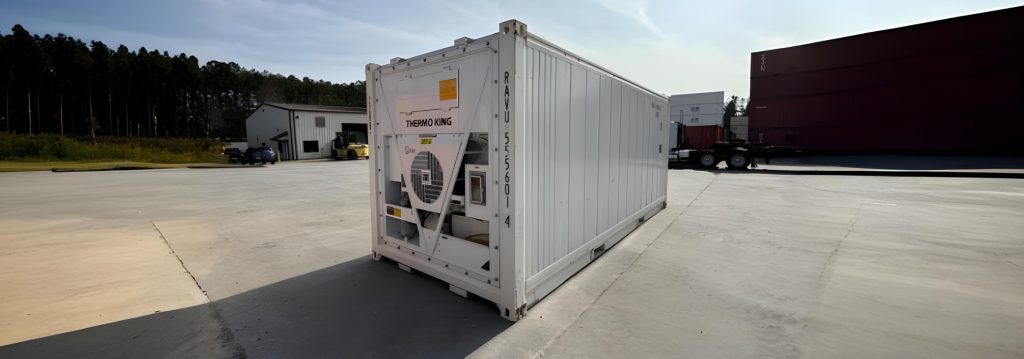
The 20’ refrigerated container is often considered the most versatile option. It provides substantial storage capacity while maintaining a relatively compact footprint, making it suitable for locations with limited space or operations that don’t require bulk storage.
Typical specifications include:
- External dimensions of approximately 20’L x 8’W x8’6”H
- Internal volume of about 1,010 cubic feet
- Power requirements of 230V or 460V three-phase
- Temperature control ranging from -20°F to 85°F
This size is commonly used for:
- Long-term storage of frozen or refrigerated food products such as meat, seafood, and dairy
- On-site cold storage at food processing facilities
- Temporary refrigeration during store remodels or seasonal demand spikes
- Pharmaceutical or biomedical storage requiring precise temperature control
Because of its manageable size, a 20-foot reefer can often be placed closer to operations, reducing travel time for loading and unloading. It is also easier to reposition if site layouts change, making it a practical choice for businesses with evolving storage needs.
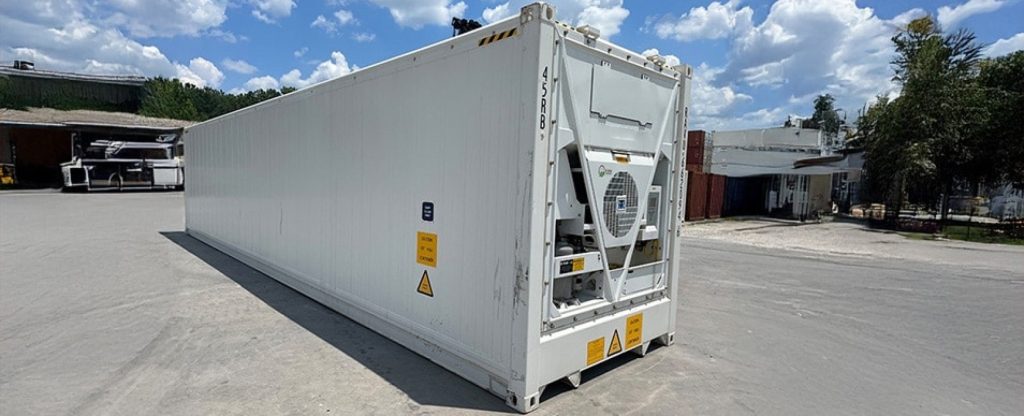
For businesses handling large volumes of temperature-sensitive goods, the 40-foot refrigerated container offers significantly more capacity. This size is great for environments where efficiency and bulk storage are priorities.
Typical specifications include:
- External dimensions of approximately 40’L x 8’W x 9’6”H
- Internal volume of around 2,380 cubic feet
- Power requirements of 230V or 460V three-phase
- Temperature range from -20°F to 85°F
40-foot reefers are commonly used for:
- Large-scale warehousing and distribution operations
- Cold chain logistics for regional or national supply networks
- Import and export of refrigerated or frozen goods
- Storage of high-value perishables for manufacturers and distributors
These containers are built with reinforced floors that support frequent forklift use and heavy pallet loads. Their size allows for organized inventory layouts and improved airflow, which can be especially beneficial when storing large quantities of similar products.
Additional Refrigerated Storage Options
Beyond standard 20-foot and 40-foot reefers, some operations benefit from specialized configurations. Refrigerated trailers can offer greater mobility for businesses that need to transport temperature-sensitive goods between locations, while walk-in coolers or freezers provide easy access for frequent entry and exit. These alternatives can complement or replace standard containers depending on how the storage will be used.
Key Factors to Consider When Choosing a Size
Selecting the right refrigerated container size involves more than just estimating how much product you need to store. Several practical considerations should guide your decision.
Storage Volume and Layout
Start by assessing not only how much product you have today, but how your storage needs may change over time. Consider pallet dimensions, stacking requirements, and airflow clearance. A container that feels “just right” now may become restrictive as operations grow.
Temperature Sensitivity
Different products have different storage requirements. Frozen foods, fresh produce, pharmaceuticals, and specialty materials all require specific temperature ranges and consistency. Confirm that the container size you choose can maintain stable temperatures even when partially loaded or frequently accessed.
Power Availability
Refrigerated containers require reliable electrical connections. Before selecting a unit, verify that your facility or job site can support the necessary voltage and phase requirements. Power availability may also influence where the container can be placed on-site.
Space and Accessibility
Larger containers require more room for delivery, placement, and safe operation. Ensure there is adequate clearance for loading equipment and personnel. In tighter spaces, a 20’ unit may offer greater flexibility, while larger yards or industrial sites can more easily accommodate a 40’ unit.
Duration of Use
Short-term needs, such as seasonal storage or temporary overflow, may call for a different approach than long-term or permanent storage. For ongoing operations, choosing a container size that supports efficiency and future growth can reduce the need for additional units later.
Mobility Requirements
If your business involves moving storage between locations, such as catering, events, or construction projects, smaller reefers or refrigerated trailers may be easier to manage. Fixed operations, on the other hand, often benefit from larger, stationary units.
Making the Right Reefer Choice
Ultimately, the right refrigerated container size depends on how your business operates day to day. A smaller unit can offer flexibility and efficiency for moderate storage needs, while a larger container supports scale, organization, and high-volume throughput. Taking the time to evaluate your current demands alongside future growth can help ensure your investment supports your operations rather than limiting them.
Finding Your Ideal Refrigerated Solution
Choosing the correct Atlanta refrigerated container size is a critical step in protecting temperature-sensitive products and maintaining efficient workflows. Container Technology offers a range of refrigerated containers and configurations to support diverse business needs, from compact 20ft units to large-capacity 40ft reefers.
With nearly 40 years of experience in Atlanta cold storage solutions and providing top-level reefers for sale Atlanta businesses trust, our team can help you identify the right option for your operation and ensure it’s ready to perform when you need it most. Request a free quote online or call us today to get started!